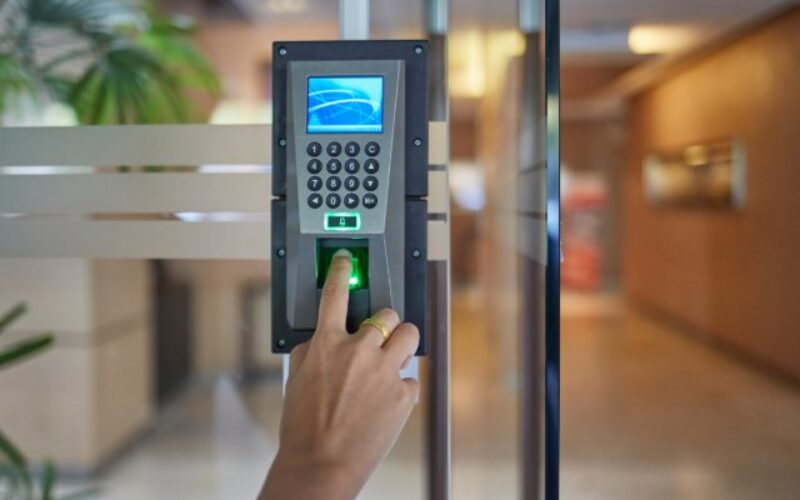

Access control systems give you a way to manage who enters and exits your commercial property. While these systems are built to be secure, they’re not invincible, and can sometimes be compromised. If you want to avoid a breach, here are the most common ways access control systems get targeted—so you know exactly what to watch out for.
Stolen or Cloned Credentials
Key cards and key fobs are easy to lose, and when they do go missing, whoever finds them has immediate access to your building. That’s the straightforward version of this problem.
The more unsettling version is cloning. With the right equipment, someone can scan a proximity card without ever touching it physically. The copied credential works just like the original, and your system has no way to tell the difference between the two. If your building still runs on older card technology without any encryption layer, cloning is a risk you’re sitting with right now.
Weak or Reused PINs
A PIN-based system sounds secure until you realize that “1234” is still one of the most commonly used codes in any setting. People pick numbers they won’t forget, which almost always means numbers that are easy to guess.
Reuse is the other side of this. When someone uses the same PIN across multiple systems or shares it with a coworker for convenience, the code spreads beyond the person it was assigned to. At that point, the audit trail loses its reliability because you can no longer connect a specific entry event to a specific person.
Tailgating and Piggybacking
No technology stops a determined person from walking through a door right behind an authorized employee. Tailgating happens when someone follows closely enough that the door doesn’t have time to close and re-lock. Piggybacking is the social version—where someone holds the door open for a stranger out of basic politeness.
Both bypass the credential system entirely. The access log shows one badge tap, but two people walked through. Without a physical barrier like a turnstile or a mantrap vestibule, this is one of the harder vulnerabilities to address through technology alone.
Outdated Systems Running Old Software
Is your access control system old? This could be a sign you need to upgrade it. Older systems run on software that manufacturers eventually stop supporting, which means no patches, no security updates, and no fixes when vulnerabilities get discovered.
Hackers look for exactly this. An unpatched system is a known target, especially when the vulnerabilities have already been published publicly in security databases. Age alone isn’t the disqualifier, but an access control system that’s stopped receiving updates has a narrowing window before that becomes a serious liability.
Physical Tampering with Hardware
The readers, controllers, and wiring that make up your access control system are physical objects, and physical objects can be tampered with. Someone with enough time at an exterior reader can sometimes bypass it by manipulating the wiring or the hardware directly.
Controller boxes that aren’t locked or aren’t housed in secure enclosures are especially exposed. If someone can reach the controller, they may be able to trigger an unlock without going through the credential process at all. Placement and enclosure type are part of the security equation, not just the technology running inside the system.
Insider Threats
Not every compromise comes from outside. A current employee, a former employee whose access was never revoked, or a contractor with broader permissions than the job required—these are all categories of insider risk.
Former employees are the most commonly overlooked. When someone leaves a company, access termination doesn’t always happen the same day. Sometimes it happens a week later. Sometimes it doesn’t happen at all. That window is long enough for someone with a grievance to use credentials that should have been deactivated the moment they walked out.
Network-Based Attacks
Modern access control systems often connect to a broader network for remote management, reporting, and integration with other building systems. That connectivity is useful, but it also creates an attack surface.
If the network isn’t segmented properly, an attacker who gets into one part of the system can sometimes move laterally toward the access control infrastructure. Default passwords on networked controllers are another entry point. Manufacturers ship devices with the same credentials, and if no one changes them during setup, the system sits open to anyone who knows the default login for that hardware model.
Credential Sharing
This one’s less dramatic than hacking, but it’s surprisingly widespread. Employees share credentials with each other to skip the hassle of badging in, help a coworker who forgot their card, or let a vendor through without waiting for someone to escort them. None of it is usually malicious.
The problem is that shared credentials destroy the traceability the system was built to provide. You lose visibility into who was actually in the building during a specific window, which becomes a serious issue if something goes wrong and you need to reconstruct a timeline.
Replay Attacks on Wireless Systems
Some wireless access control systems transmit credential data in a way that can be intercepted and replayed. In a replay attack, someone captures the signal from a legitimate credential being used and then rebroadcasts that same signal later to trigger the same unlock.
This is more technical than most of the vulnerabilities on this list, but it’s a known method with documented use cases. Systems using encrypted rolling codes are considerably harder to hit with this approach because the credential changes with every use. Older fixed-code systems don’t have that protection.
Propped Doors and Manual Overrides
Sometimes the vulnerability isn’t the access control system at all. It’s a door that’s been propped open with a wedge because the loading dock crew got tired of badging in every time. Or a manual override that was used during a maintenance window and never re-engaged.
Door monitoring alerts exist for this reason. A system that tracks door position and flags a door that’s been held open beyond a set time gives you the ability to respond before someone walks through an unmonitored gap. Without that monitoring, a propped door can go unnoticed for hours.
The Bigger Picture
No access control system is a complete barrier on its own. The technology handles a lot, but the gaps that get exploited are the ones nobody thought to watch—the door propped open at shift change, the card that was cloned three months ago, the former employee whose access was never removed.
Knowing where these vulnerabilities sit is the first step toward closing them. Whether that means adding door monitoring, tightening your offboarding process, or auditing who still has active credentials, each improvement reduces the window of exposure your building is carrying right now.
Image Credentials: SOMPETCH, 188220961
-------------------------------------------------------------------------------------------------------------
-------------------------------------------------------------------------------------------------------------
home remodeling reference (links to internal page)
 |
 |
 |
 |
| directory | photos | forms | guide |
Helpful article? Leave us a quick comment below.
And please share this article within your social networks.