Because these systems are very common in most places nowadays, it is important to know about their basics before spending your money on them. So let’s review how heating and cooling systems work:
All climate control systems have three main components:
- A source of cool or heated air
- A way of distributing the air to the rooms that need to be cooled or heated
- A way of controlling or regulating the system
Principles of Heating and Cooling

These systems often use the same distribution and controlling systems. In the case of central air conditioning, cool air flows through the same ducts as heated air and the same thermostat regulates both.
Both of these systems work on the same principle that heat moves from a warm area to a cooler one. Heating systems create heat into the air to make the home warmer, while cooling systems remove heat to make the home cooler.
Source of their Working
All of these systems use some kind of fuel. Air conditioners typically run on electricity while heaters use gas, fuel, oil, or electricity.
When the furnace is turned on, the respective fuel is consumed and distributed to different areas of the home through wires or ducts, and then blown out through radiators, registers, or heating panels.
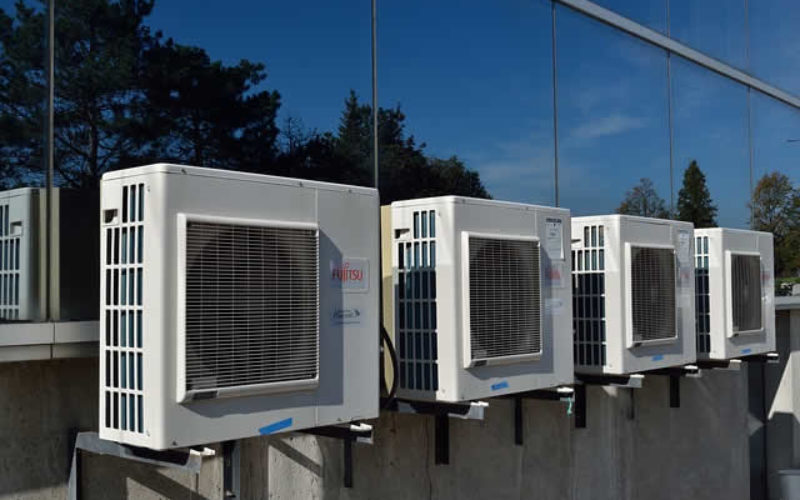
When an air-conditioner turns on, the electricity cools a gas in a coil to its liquid state. The warm air in the office is cooled by coming in contact with this coil and then distributed through ducts or registers or directly through the unit.
Distribution Systems
Once air is heated or cooled, it must be distributed to different areas. There are three types of distribution systems used by these devices:
-
Forced Air Systems:
In this type, the heat produced by the furnace or the cool air produced by the fan of an air-conditioner, known as a blower, forces the air through a set of metal pipes to different rooms. As the warm air flows to the different areas, the cooler air flows back through a separate set of pipes to the furnace to be heated. Air-conditioners work in the reverse way, where cool air is sent to the rooms, and warmer air is brought back to be cooled.
-
Gravity Systems:
These work on the principle that cold air goes down while hot air goes up. They are not used for cooling but for heating. The furnace is situated near or below the floor and the warm air rises through ducts to registers in the floor. The registers must always be placed higher than the furnace. The warmer air rises up. As it cools, it sinks downwards, enters the return ducts and goes back to the furnace to be heated’
-
Radiant Systems:
Radiant systems heat the floors, walls, and ceilings of rooms by warming radiators in the rooms. The radiators warm the air. Radiant systems also work only for heating.
other valuable tips:
Heating and Cooling System Controls
Heating and cooling systems are controlled by a regulating heat-sensitive switch known as the thermostat. It is sensitive to the changes of temperature and switches the furnace or the air conditioner on or off to maintain the temperature at a level that has been set, known as the set point.
Image Credit: Pixabay
end of post … please share it!
| google+ |
GUIDE: market planning module
-------------------------------------------------------------------------------------------------------------
-------------------------------------------------------------------------------------------------------------
home remodeling reference (links to internal page)
 |
 |
 |
 |
| directory | photos | forms | guide |
Helpful article? Leave us a quick comment below.
And please share this article within your social networks.