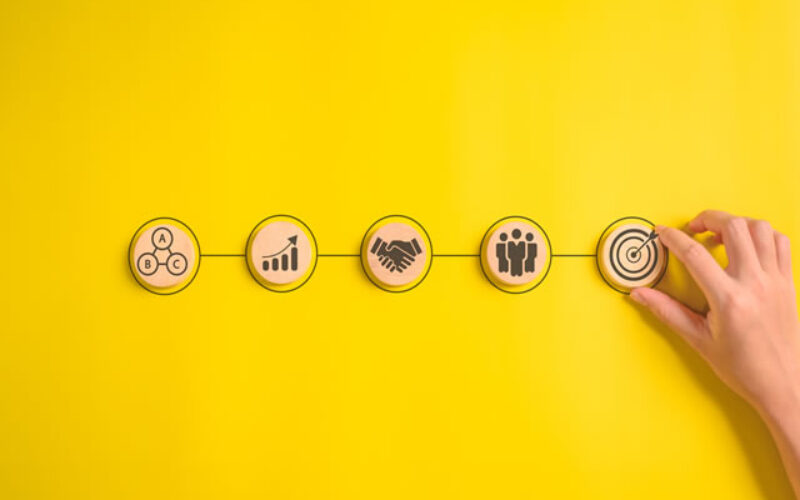
It’s a concept, similar to the marketing mix and the 4 P’s of marketing, that’s studied by marketing and business professionals across the world. It involves 5 key stages starting with awareness and ending with advocacy.
Many businesses are aware of this marketing concept, but don’t use it to its full potential or within their marketing strategies at all.
When used correctly, mapping out your customers’ buying journey can help improve business growth and sales conversions. But how exactly? In this article, we will discuss how businesses can use the customer journey to boost sales.
- post content
- Awareness
- Consideration
- Decision
- Retention
- Advocacy
- collective business notes
Awareness
The customer journey model starts with awareness. At this stage, the customer may be unaware of your business entirely, and in the early stages of exploring your products and services.
Maybe they’ve found your website through an ad, or perhaps your products had been recommended to them by a previous customer who left you a review online. Wherever a prospect comes from, they will first interact with your business in this stage.
Businesses need to recognise that in this stage, customers will likely have a problem at the forefront of their minds, and one that they’re looking for a solution to. Your business could just be that solution if you use the customer journey concept correctly.
With their problem and a desire to find a resolution, a customer will then come across your business either passively or actively.
Active discovery means a prospect has searched for an answer or solution to the problem they have. Contrastingly, passive discovery occurs when they come across an ad, just as we mentioned before.
Understanding when a customer is in the awareness stage is important, as it can ensure businesses share the right content with these customers to encourage them to interact with the business further.
Here are some helpful marketing tactics that businesses should use for customers in the awareness stage:
- SEO (Search Engine Optimisation) – techniques aimed at improving visibility on search engines like Google
- Social Media Marketing – share engaging and high-quality content online, communicating who you are and what you do.
- Paid social and Google search ads – run ads for top-of-funnel audiences that use creative storytelling and relatable scenarios to capture audiences online.

Consideration
After audiences become aware of your business and its products and services, they then move into the consideration stage. At this point, they’re evaluating what you offer, as well as comparing these to other competitors.
Marketing to audiences in the consideration stage involves sharing information with customers so that they can feel confident in choosing your business.
For a B2B business such as Semrush, that could be through sharing a case study from a customer who used their SEO tools and the growth it allowed them to achieve.
For a B2C business such as Snapfish UK, this may be sharing a positive testimonial from a customer who had recently purchased one of their personalised calendars.
Here are a few examples of the different types of content businesses should share with audiences in the consideration stage of their customer journey.
- How-to guides and information or educational blog posts
- In-depth case studies sharing results from real clients
- Customer testimonials
- Product demonstrations
Decision
Now that a customer has thoroughly compared your site to other competitors, it’s time for them to make a decision. They are ready to select the exact product or service that they require, but may also make one final check to be sure they’re choosing the right option.
In this moment, it’s likely the customer will consider factors like cost and experience in order to feel reassured in their decision. No matter how close a customer is to making a purchase or signing up for a service, businesses still have the opportunity to share content so that their decision is made easier.
There are several different ways that businesses can share content to encourage a prospect to successfully convert into a customer.
For example, marketing teams could focus on offering free trials so that customers can test out your services without committing financially. Businesses could also simply offer them a free phone call consultation, where they can ask any questions or solve any queries they have.
Retention
Hooray! A customer chose your products or services and successfully made a purchase. But the work for marketing professionals doesn’t end there.
Now that the customer’s information is stored in your database or CRM system, you can use tactical marketing techniques to encourage customers to return in the future or use your business again.
Many businesses typically focus their marketing efforts and budget on initiatives aimed at acquiring new customers. While expanding your customer base is important for business growth, generating sales and enquiries from existing customers is a much easier and more affordable process.
Retention is all about personalisation and making customers feel valued. Businesses can achieve this through offering promotional freebies and incentives to customers who have the highest spend with your business or return the most consistently.
Similarly, touchpoints from your brand to returning customers should be personalised so that their shopping experiences are quicker, easier, and tailored to their needs and behaviours.
Advocacy
The final stage of the customer’s journey is advocacy, where customers become advocates of your brand, encouraging others to try out your products or services. In this stage, businesses can create and launch referral programmes that reward customers for bringing in new customers.
Additionally, loyal customers can be converted to brand ambassadors by businesses encouraging them to share their feedback, then sharing these reviews across their website and social media pages. This way, customers feel valued, and the business cares about their feedback and suggestions.
Resource Citations:

Image Credit: customer journey by envato.com
end of post … please share it!
-------------------------------------------------------------------------------------------------------------
-------------------------------------------------------------------------------------------------------------
home remodeling reference (links to internal page)
 |
 |
 |
 |
| directory | photos | forms | guide |
Helpful article? Leave us a quick comment below.
And please share this article within your social networks.