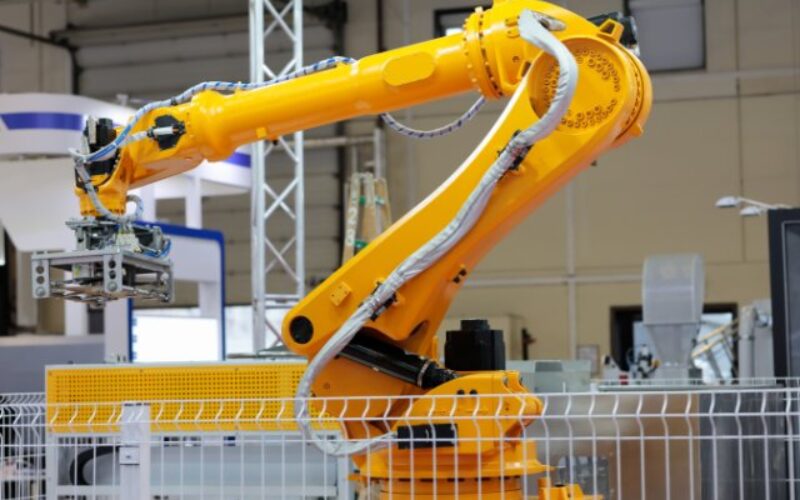
Understanding the benefits of robotic palletizers for warehouses can help managers decide if automation fits their facility and its growth plans. By taking over physically demanding tasks, robotic equipment can support smoother workflows and give employees more time for work that requires judgment.
Increase Palletizing Speed
Manual palletizing depends on the pace and endurance of individual employees. Workers naturally slow down during long shifts, especially when they handle heavy or awkward products. A robotic palletizer maintains a steady cycle rate throughout production. It places each item according to a programmed pattern without losing focus or taking unscheduled breaks.
This dependable pace helps warehouses move finished goods away from production lines before backups occur. When demand rises, managers gain a more predictable foundation for planning schedules. The system will not solve every throughput issue, but it can remove a common constraint at the end of the line.
Improve Workplace Safety
Repeatedly lifting products from a conveyor and placing them at different pallet heights puts strain on the body. Each cycle may force employees into awkward positions. Over time, this motion can contribute to fatigue and injuries that disrupt work. Robotic palletizers handle those demanding movements instead.
Reducing manual lifting allows managers to assign employees to safer responsibilities that use their problem-solving skills. Workers can monitor equipment or coordinate material flow. Proper guarding and thorough training remain essential because any industrial automation requires careful operation.
Create Consistent Pallet Loads
Stable pallets protect products as they travel through the warehouse and across the distribution network. Small placement errors can accumulate as employees build each layer. Cases may overhang the pallet, leave gaps, or shift under pressure. A robot follows the selected pattern with repeatable positioning, which produces uniform loads.
Consistency can reduce the chance of products falling during handling. It also helps stretch-wrapping equipment apply film around evenly shaped loads. Forklift operators can move well-built pallets with greater confidence, and trailers can accommodate them more efficiently.
Understand the Operating Process
Learning how palletizing robots operate makes it easier to evaluate their role within a warehouse. Products typically arrive at the cell on a conveyor. Sensors identify their position, and a robotic arm uses an end-of-arm tool to pick up one item or an entire row. The arm then places the product on a pallet according to a stored pattern.
The appropriate tool depends on the handled items. A gripper may lift cases, while another design may support bags or pails. Some cells also manage slip sheets or empty pallets. Operators use controls to select recipes when products change. This programmable process allows one system to handle various load configurations when engineers design the cell accordingly.
Use Warehouse Space Effectively
Space carries real value in a busy warehouse. Traditional palletizing layouts may require broad work areas for employees, product accumulation, and manual movement. Many robotic cells use compact layouts that fit near the end of an existing line. Their exact footprint depends on safety barriers and supporting equipment.
A thoughtful design can improve traffic around the palletizing zone and make product flow easier to manage. Some robots can serve more than one line, which may reduce duplicated equipment. Warehouses can use reclaimed floor space for staging or future expansion. Managers should review spatial constraints and access requirements before choosing a layout.
Address Labor Challenges
Warehouses often struggle to keep repetitive, physically demanding positions staffed. High turnover forces supervisors to spend time recruiting and training replacements. Robotic palletizers provide dependable support for tasks that employees may find difficult to sustain over time. Automation can stabilize output even when the available labor pool changes.
The technology does not eliminate the need for capable employees. Facilities still need people to oversee production, respond to faults, and maintain the cell. Automation shifts labor toward roles that involve technical knowledge and decision-making. Employers can prepare current workers for these responsibilities through structured training, creating opportunities for skill development within the operation.
Control Long-Term Operating Costs
A robotic palletizer requires an upfront investment in equipment, integration, guarding, and employee training. Managers should compare that expense with the ongoing cost of manual palletizing. Relevant considerations include overtime, turnover, injury-related disruption, and damaged products. Maintenance costs and energy use also belong in a complete financial review.
The strongest return usually comes from solving a clearly defined operational problem. A facility with steady volume and repetitive loads may gain more value than an operation with irregular demand. Managers can estimate payback by documenting current performance and expected improvements. This analysis helps the company invest based on realistic conditions rather than assumptions.
Improve Planning and Reliability
Predictable palletizing gives warehouse managers clearer information for coordinating downstream work. When the cell maintains a known cycle rate, teams can plan forklift pickups and overall staging or shipping activity more accurately. Consistency also makes unusual delays easier to recognize because performance follows an established baseline.
Robotic systems require preventive maintenance to preserve that reliability. Teams should follow service schedules while keeping critical replacement parts available. Trained operators can identify warning signs before minor issues interrupt production. With disciplined care, the equipment can provide stable long-term service and support more confident operational planning.
Prepare for Successful Integration
Successful automation begins with a detailed review of products and current workflows. Integrators need accurate information about package dimensions, weights, line speeds, and desired pallet patterns. They must also understand available utilities and the space surrounding the installation. Clear requirements prevent costly surprises during commissioning.
Managers should involve operators and maintenance employees early in the project. Their practical knowledge can reveal workflow concerns that drawings may miss. Early involvement also helps employees understand why the company is automating the task. Thorough training gives the team confidence to operate the system and complete routine checks, responding appropriately when a fault occurs.
Build a Stronger Warehouse Operation
Evaluating the benefits of robotic palletizers for warehouses requires more than comparing equipment specifications. The best system should address a real bottleneck while matching the products and supporting the people responsible for daily operations. With careful planning, robotic palletizing can improve safety and create dependable loads while helping the facility respond to changing demand. A qualified integration partner can assess the application and design a cell around realistic goals. When managers pair suitable technology with employee training, they can build a more efficient end-of-line process that supports sustainable long-term growth.
Image Credentials: By gen_A, 780988619
end of post … please share it!
-------------------------------------------------------------------------------------------------------------
-------------------------------------------------------------------------------------------------------------
home remodeling reference (links to internal page)
 |
 |
 |
 |
| directory | photos | forms | guide |
Helpful article? Leave us a quick comment below.
And please share this article within your social networks.